
“View from the Window at Le Gras” is widely regarded as the first-ever photograph captured with a camera. Created by Joseph Nicéphore Niépce, this groundbreaking image is a view from his estate in Saint-Loup-de-Varennes, France.
It marks the birth of photography. It’s a medium that would go on to revolutionize art, science, and communication. The photograph laid the foundation for all subsequent photographic advancements. It demonstrated the potential of using light-sensitive materials to permanently capture visual scenes.
In the early 19th century, the world was undergoing significant transformations brought about by the Industrial Revolution. Innovations in science, technology, and the arts were reshaping society. However, visual documentation was limited to paintings, sketches, and engravings.
The invention of photography emerged during this period of rapid change. A desire grew for new ways to record and understand the world. Niépce’s experiment not only fulfilled this need but also opened the door to an entirely new way of preserving history.
Niépce’s photograph was not widely known during his lifetime. The image was created as part of his private experiments and remained largely obscure until the 20th century.
It wasn’t until the 1950s that historians rediscovered the original plate. Now, it is preserved at the Harry Ransom Center at the University of Texas at Austin. The photograph has since been extensively studied and celebrated as a pivotal artifact in the history of photography.
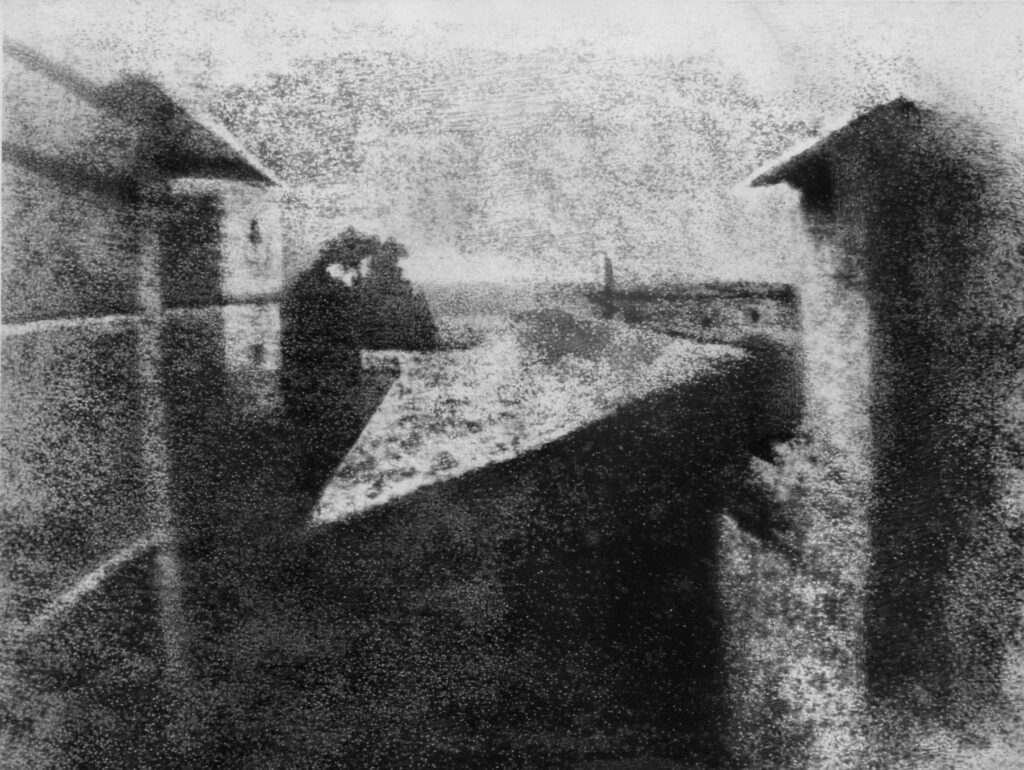
Photographer: Joseph Nicéphore Niépce
Date: 1826 or 1827
Location: Le Gras Estate, Saint-Loup-de-Varennes, France
Niépce created this photograph using a process he called heliography (“sun writing”). This process involved coating a pewter plate with a light-sensitive substance made from bitumen of Judea. He placed the plate inside a camera obscura and positioned it to capture a view from his window. The exposure time was exceptionally long, requiring 8 hours of continuous sunlight to create the image.
The resulting photograph depicts rooftops, trees, and other structures surrounding Niépce’s estate. Because of the extended exposure time, the sun appears to illuminate both sides of the buildings simultaneously.
Niépce’s primary goal was to create a permanent image, unlike earlier experiments that faded over time. This image succeeded in achieving that, but the process was complex and slow. This paved the way for further refinement by pioneers like Louis Daguerre. He partnered with Niépce before developing the daguerreotype process.
“View from the Window at Le Gras” is a milestone in human innovation. It represents the birth of photography, a medium that has since become an indispensable part of many areas. Art, science, journalism, and personal expression are just some.
Niépce’s success also inspired others to develop faster, more practical photographic methods. This lead to the rapid evolution of the technology. Today, the photograph is a revered artifact. In fact it signifies the moment when humankind first captured a scene permanently using light.
Full Name: Joseph Nicéphore Niépce
Birth: March 7, 1765, in Chalon-sur-Saône, France
Death: July 5, 1833, in Saint-Loup-de-Varennes, France
Niépce was an inventor driven by curiosity and a desire to innovate. Before his experiments with photography, he worked on creating an early internal combustion engine. His fascination with capturing images led him to experiment with light-sensitive materials. This culminated in his invention of heliography.
Despite his achievements, Niépce struggled with financial and technical challenges. His collaboration with Louis Daguerre showed promise but did not bear fruit during his lifetime. Daguerre later built upon Niépce’s work to create the daguerreotype, which gained widespread popularity. Niépce’s contributions, however, remain fundamental to the history of photography.
DID YOU KNOW?
• The Camera Used: Niépce used a camera obscura, a simple device that projects an image of its surroundings onto a surface. His version was modified to accommodate the light-sensitive plate.
• Fading and Restoration: The original plate suffered from degradation over time. Modern technology has helped enhance and analyze the faint details. It allows us to understand the composition of the photograph better.
• Chemical Complexity: The bitumen used in the heliographic process hardened when exposed to light. this is what created the permanent image. Niépce then washed the plate with a mixture of lavender oil and white petroleum to remove the unexposed areas.